A new manufacturing playbook - Edge Factories
A COO stares at a supply-chain map after the latest disruption: another delay, another tariff, another quarter where “efficiency” meant one mega-plant and one very long rope to the customer. The ones rethinking the game are doing something different — they’re treating the factory itself as a product.
For decades, global manufacturing followed a simple logic: build large factories in low-cost regions and ship finished products around the world. That model created highly optimised supply chains — and long transport routes, geopolitical exposure, and massive capital investments. Today, trade barriers, logistics disruptions, and the demand for faster market access are forcing a rethink.
A new playbook is emerging. Instead of shipping products globally, deploy standardised factories near the markets you serve. That concept is Edge Factories.
What is an edge factory?
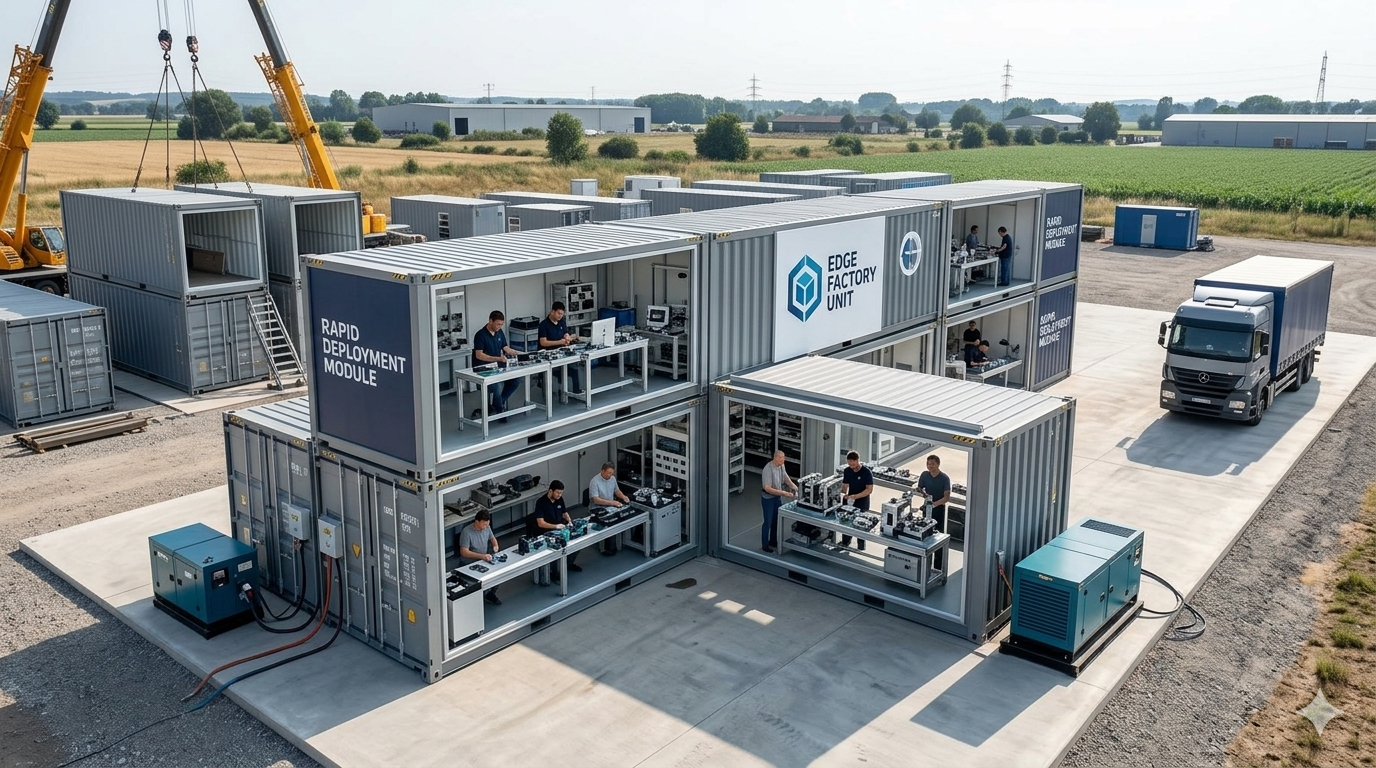
An edge factory turns manufacturing into a deployable system — automated, modular production units that can be installed near any market, enabling companies to produce locally instead of shipping globally.
To scale that system, you need software to capture the know-how and deliver the operational playbook to every edge site. Without it, each location runs on tribal knowledge and long training cycles. With it, a new operator can be productive in weeks.
Old model vs Edge factory playbook
In many industries, the gap between the two approaches shows up in measurable ways:
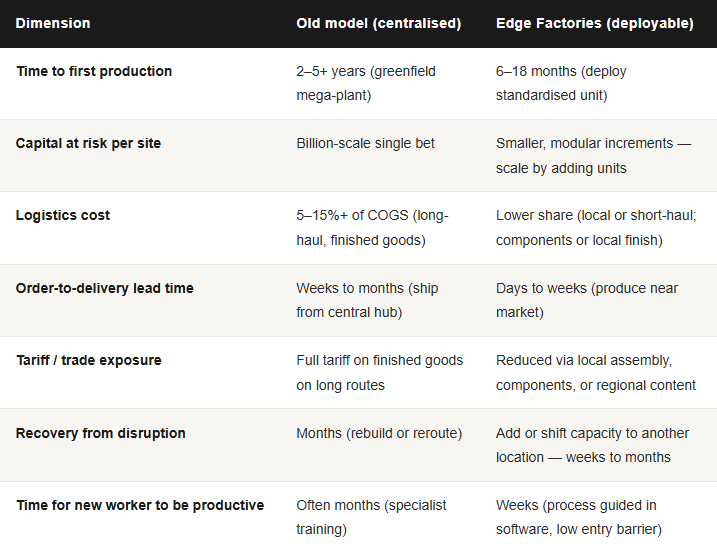
The direction is consistent: deployable, local production reduces time, risk, and cost — while making recovery from shocks faster.
Core in the Centre, Assembly at the Edge
Edge factories do not mean eliminating the central factory. They mean changing its job.
Think McDonald's: the brand runs centralised production of the things that define quality and consistency — proprietary ingredients, key components, specs and processes — while partner or franchise units do final assembly and delivery close to the customer. The same pattern applies in manufacturing.
The central factory produces the core: critical components, semi-finished modules, proprietary parts, or consumables that are hard to replicate locally. It runs at scale, keeps IP and quality under one roof, and ships to the network — not finished products to end customers.
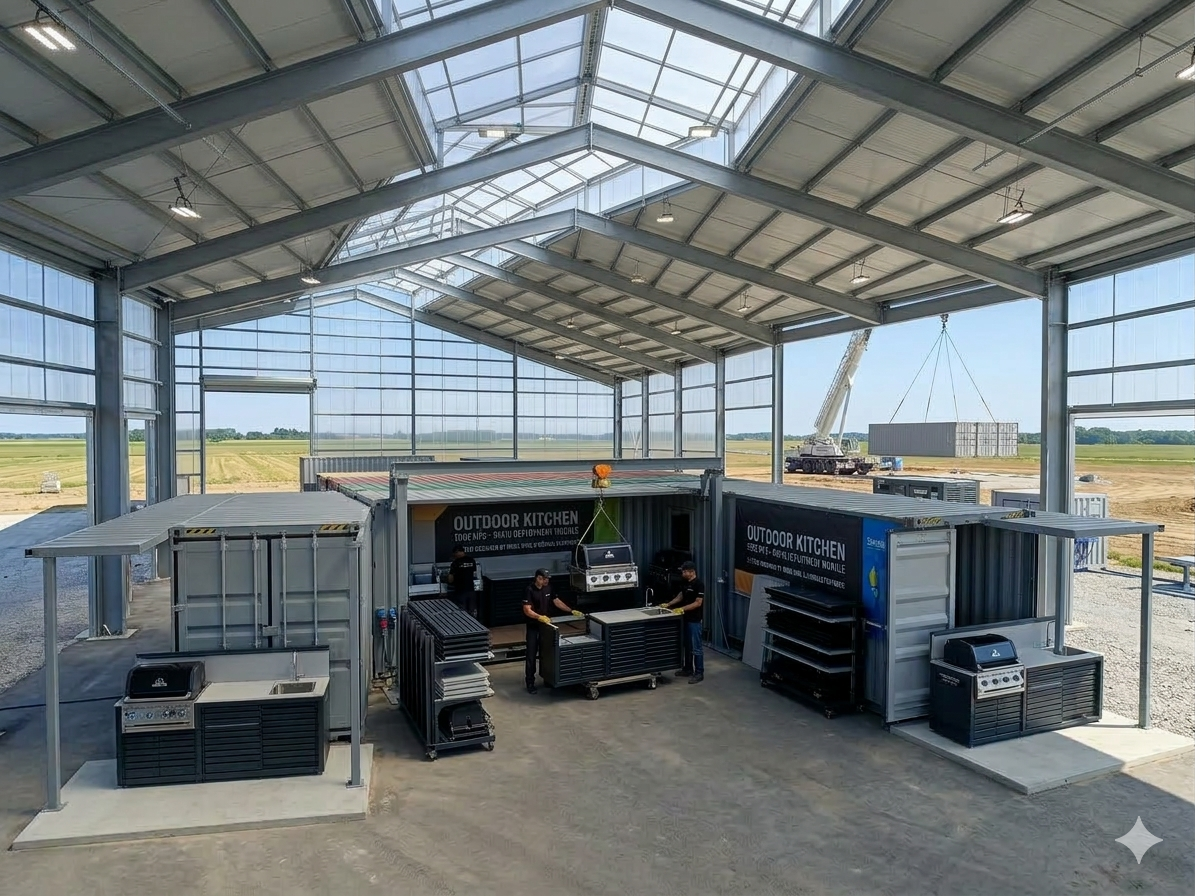
Partner or franchise units — the deployable edge sites — receive those core elements and perform final assembly, local configuration, or finish. The product reaches the market with short lead times, lower logistics cost, and less tariff exposure.
“You keep the benefits of centralised scale and consistency where it matters, and push assembly and delivery to the edge where speed and locality matter.”
Process Captured in Software
Making the edge factory work at scale depends on turning your best practice into a repeatable, guided process. The full flow — from sales order to manufacturing order to production and shipment — is mapped, designed, and automated in software.
Every step and the know-how behind it are captured in the system. The network no longer runs on tribal knowledge or long training cycles; it runs on a single, clear process that software guides people through. You design and improve the process once. Every edge site runs it the same way.
People: productive in weeks, not months
A major bottleneck in manufacturing today is skilled labour. Edge factories don't have to rely on scarce specialists. Because the process is designed and guided in software, a non-technical person — someone from a store, a shop, or another industry — can join an edge factory and be productive in weeks, not months.
Low entry barriers help you staff local sites and offer genuine career shifts into high value-adding manufacturing without years of prior experience. You mitigate the skills shortage while making the edge factory simple to operate and scale.
Why This Model Matters
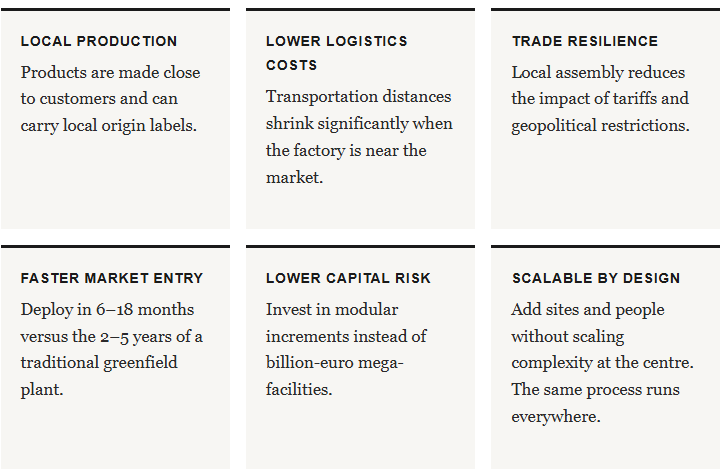
When the factory becomes a product, you unlock a set of advantages that compound over time:
“Don’t ship products. Ship factories.”